Net Worth Tracking for Anxious People
If money makes your brain loud, you do not need more detail. You need clarity at the right level.
TL;DR
Money anxiety grows in uncertainty.
Net worth tracking gives you one calm reference point.
Less fog means more confidence and easier money decisions.
The kind of anxiety this is for
Some people avoid money because they do not care. Many people avoid money because they care deeply.
Money anxiety is rarely about numbers alone. It is about not knowing.
Not knowing if you are safe, if you can afford something and if a decision would be responsible or not.
When you do not look, everything stays possible. That could sounds comforting, but it is more often a source of anxiety.
This is where a simple net worth habit helps.
What unknown does to decisions
When your finances feel vague, your brain fills the gaps.
- It overestimates risk.
- It underestimates progress.
- It treats every choice as dangerous.
You start thinking:
- I probably cannot afford this move
- I should not change jobs yet
- I should not invest/save more
- I should not enjoy this purchase
Not because you checked and decided no. But because you never had a clear yes or no.
Clarity does not force action. It gives you permission to decide.
Why net worth helps more than detailed tracking
Net worth is what you own minus what you owe. It is not detailed, and that is the point.
I tried budgeting apps, expense trackers, and complex spreadsheets. They made me think about money constantly. They did not make me calmer.
For anxious people, more detail often means more stress. Net worth tracking works at the right distance.
It gives you:
- One stable financial reference point
- A way to see progress even in messy months
- A sense of scale that reduces catastrophizing
- Enough information to decide, not enough to spiral
It turns money from a feeling into information.
A useful shift
You are not trying to optimize your finances.
You are trying to replace uncertainty with reality.
Reality is usually more manageable than imagination.
The rules that keep the fog away
This only works if it stays simple.
- Totals only. No transactions or categories.
- One line per account.
- Update slow things less often.
- Use consistent estimates.
- Check once a month.
More often does not mean more clarity.
The five minute routine
Once a month, same day if possible.
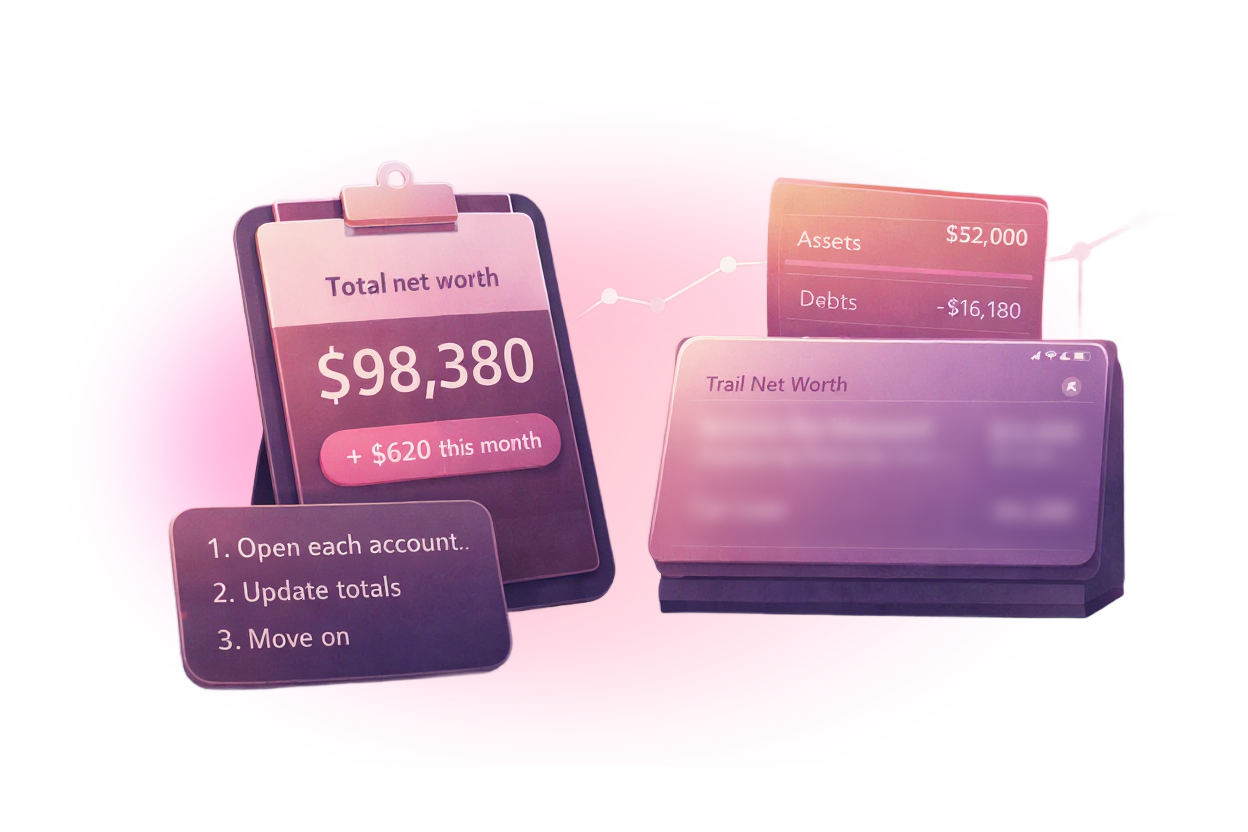
- Open each account and note the current balance
- Update your list with totals only
- Look at your total net worth and the change since last month
- Close it and move on
That is it.
The power is not in staring at the number. The power is in knowing that you looked.
What happens when the number changes
When net worth goes down
When my number drops, my first instinct is still to tense up. Then I remind myself. A down month usually means something happened.
Bills. Travel. Repairs. Market swings. Timing.
Seeing the number stops my brain from inventing stories.
If it was expected, I move on.
If it was unexpected, I investigate calmly.
Both feel better than vague worry.
When net worth goes up
This matters too.
Anxious people notice risk easily.
We often miss progress.
Seeing growth written down makes it harder to dismiss.
It builds quiet confidence.
When you have debt
Debt feels heavier when it stays abstract. Tracking it makes it concrete. Concrete things can be worked with.
You stop thinking in terms of shame. You start thinking in terms of progress.
What to include without overthinking
Keep the list short.
Assets:
- Current accounts
- Savings
- Investments
- Pensions
- Property
- Vehicles (Depreciating assets)
Debts:
- Mortgage
- Loans
- Credit cards
If you hesitate, skip it and add it later.
The goal is clarity, not completeness.
Gentle valuation rules
Use numbers you can repeat.
- Cash and savings. Total on update day
- Investments. Provider total on update day
- Pensions. Latest number, quarterly
- Property. Conservative estimate, twice a year
- Vehicles. Guide price, twice a year
Consistency beats precision.
What changes after a few months
You stop guessing.
You stop assuming you cannot do things.
You stop delaying decisions out of fear.
You stop treating money as an unknowable force.
You may still say no.
But it will be a conscious no.
That is the difference.
If you try one thing
Try three monthly updates.
Do not refine the system.
Do not add detail.
Do not judge yourself.
Just look once a month.
For many anxious people, that alone is enough to turn money from something that blocks action into something that quietly supports it.
Try Worth It
Keep assets and debts in one place.
Get one total, a clear monthly change, multi currency support, sync, and export.
Learn more about Worth it