A Simpler YNAB Alternative
If you like the idea of understanding your money but do not want categories, transaction tracking, or bank sync, you may be looking for a simpler alternative to YNAB.
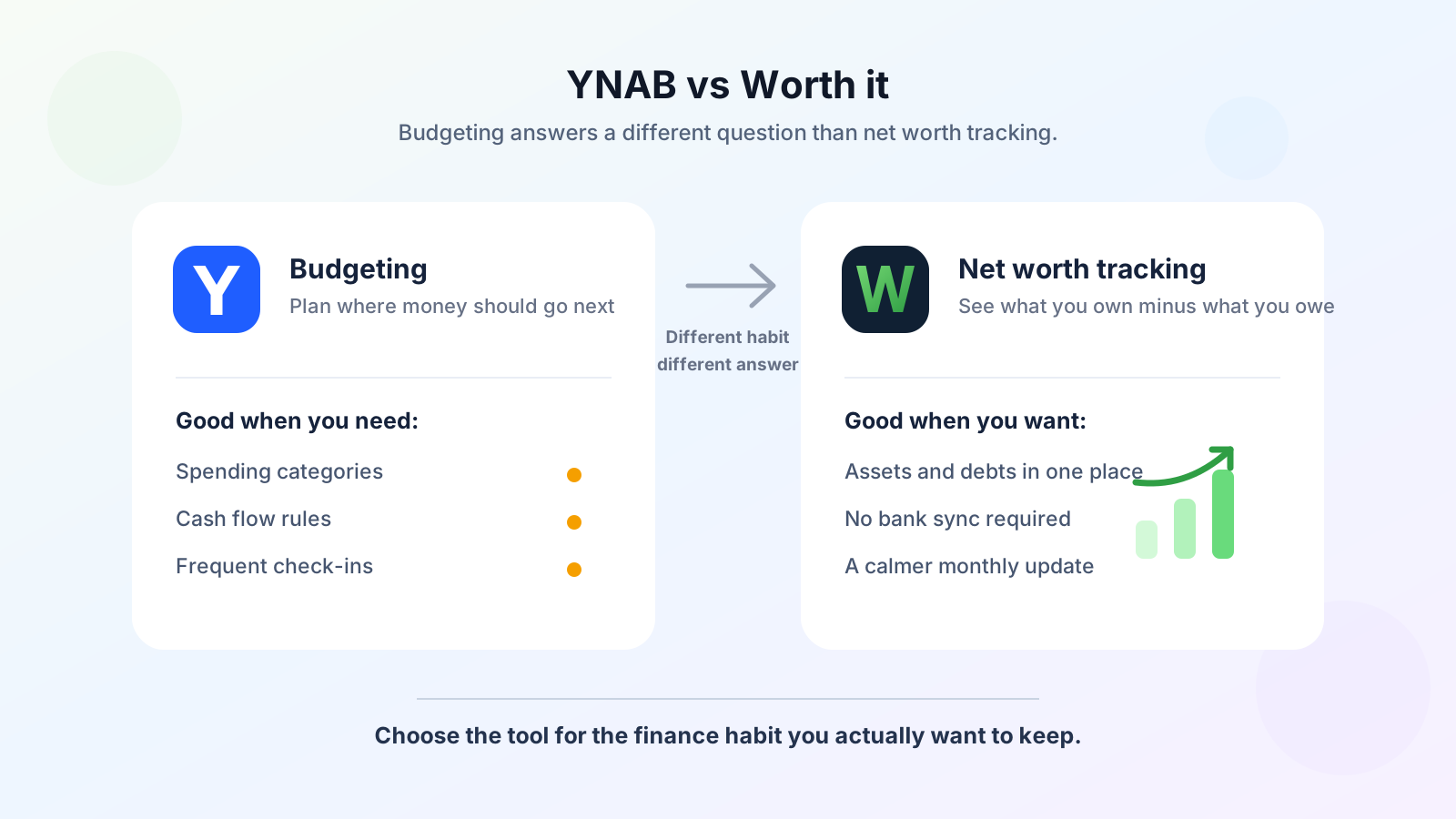
Quick answer
Use YNAB if you want a real budgeting system, spending categories, and a plan for what your money should do next.
Use Worth it if you do not want to budget, but still want a calm monthly view of your net worth, assets, debts, savings, investments, property, and progress.
The main difference
The simplest way I think about it is this:
YNAB is about managing cash flow. Worth it is about understanding your financial position.
| Feature | YNAB | Worth it |
|---|---|---|
| Main focus | Budgeting and cash flow | Net worth and assets |
| Best for | Planning how to use your money | Seeing what you own and owe |
| Daily tracking | Often useful | Not needed |
| Transaction categories | Central to the workflow | Not part of the app |
| Bank sync | Useful for keeping budgets updated | Not required, manual by design |
| Assets like property, pensions, crypto, collectibles | Possible, but not the main focus | Built for this |
| Routine | Frequent budget check-ins | A calmer monthly update |
| Good fit if you think | "Where should my money go?" | "Where do I stand?" |
YNAB asks questions like:
- What money do I have available?
- What should that money be used for?
- Am I staying inside my categories?
- What changed in my spending?
Worth it asks a different set of questions:
- What do I own?
- What do I owe?
- What is my net worth today?
- Is the overall direction improving?
- What changed since last month?
Both approaches can be useful. They are just not the same habit.
When YNAB makes sense
YNAB can be a good fit if you want to actively manage your budget. It is built around planning your money before you spend it, assigning money to categories, and adjusting those categories as life changes.
That can be powerful if you:
- want a detailed spending plan
- need help controlling cash flow
- like assigning money to categories
- want to track transactions closely
- are trying to get out of debt with a structured budget
- enjoy checking your finances often
For many people, that level of attention is exactly what helps.
When Worth it makes sense
Worth it is for a different kind of finance routine.
It may be a better fit if you:
- do not want to track every transaction
- do not want to categorise spending
- prefer not to link bank accounts
- care more about monthly progress than daily spending
- have assets spread across banks, pensions, investments, property, crypto, or other places
- want something simpler than a spreadsheet
Worth it is intentionally not a budgeting app. You manually add your accounts, assets, and debts, then update their total values when you want. From that, you can see your net worth, history, changes, insights, and overall financial picture.
No categories. No bank sync. No daily money admin.
Budgeting can be useful, but it is not the only way
I think this part matters.
Personal finance advice often treats budgeting as the default. If you want to be good with money, make a budget. Track spending. Categorise transactions. Optimise the month.
That works for some people. But for others, it creates friction.
When I tried budgeting apps, I found myself focusing on the wrong things. A single weird transaction category could bother me. Broken bank sync could make the whole system feel unreliable. Some months, I simply did not want to explain my spending to an app.
What I wanted was not a perfect account of every transaction. I wanted a simple way to know whether I was moving in the right direction.
That is where net worth tracking helped.
Net worth tracking is a calmer check-in
Net worth tracking is simple:
assets - debts = net worth
Once a month, you update the total value of each account or asset. Cash, savings, investments, pensions, property, vehicles, credit cards, loans, mortgage, and anything else that matters to you.
Then you look at the total.
That number will not tell you everything. It will not replace a budget if you need one. But it gives you a clear reference point:
- Am I building savings?
- Are investments growing?
- Is debt going down?
- Did property, pension, or other assets change?
- Is my overall financial life becoming stronger?
For me, that is a more sustainable habit than daily budgeting.
If you want to see exactly how that habit works, here is how I track my net worth manually without bank sync.
Bank sync vs manual tracking
YNAB and many budgeting apps often work best when transactions flow in automatically. That can be convenient, especially if you want to keep a budget up to date.
Worth it goes the other way on purpose.
Manual tracking means you type the totals yourself. It is less automatic, but it has a few advantages:
- it works for assets that banks cannot sync well, like property, pensions, vehicles, collectibles, or private investments
- it avoids broken bank connections
- it keeps banking credentials out of the app
- it makes the check-in intentional
- it keeps the app focused on the big picture
The trade-off is obvious: you need to update the numbers. But if your routine is monthly, that can be a feature rather than a problem.
Spreadsheet vs Worth it
If you are choosing between YNAB and Worth it, you may also be considering a spreadsheet.
A spreadsheet is a great place to start. You can list accounts, values, debts, and dates. It is flexible and free.
Worth it becomes useful when you want the same manual approach with less maintenance:
- charts and net worth history
- asset categories
- multiple currencies
- widgets
- spreadsheet import
- sync across devices
- exports
- a cleaner mobile and Mac experience
The idea is not to replace every spreadsheet. It is to make the simple net worth habit easier to keep.
Which one should you choose?
Choose YNAB if your main problem is:
- "I need to control my spending."
- "I want to plan my money before I spend it."
- "I need categories and rules."
- "I want to actively budget."
Choose Worth it if your main problem is:
- "I want to know where I stand."
- "I do not want to budget."
- "I want to track assets and debts in one place."
- "I want a monthly check-in, not daily finance homework."
Some people may even use both: YNAB for budgeting, Worth it for net worth. But you do not need both if only one habit fits your life.
Why I built Worth it this way
I built Worth it because I wanted personal finance to feel calmer.
I did not want to connect every bank account. I did not want to track every coffee. I did not want an app that made money feel like a daily performance review.
I wanted one clear view:
What do I own, what do I owe, and how is that changing?
That is the whole philosophy. A simple look at your finance, no budget needed.
The short version
If you want to plan your money before you spend it, use a budgeting app like YNAB.
If you want a simpler way to see your full financial picture, use a net worth tracker like Worth it.
The difference is not which app is "better". It is which habit you actually want to keep.
Worth it
Track your net worth without budgeting
Keep assets and debts in one place, update balances manually, and see how your money changes over time.